
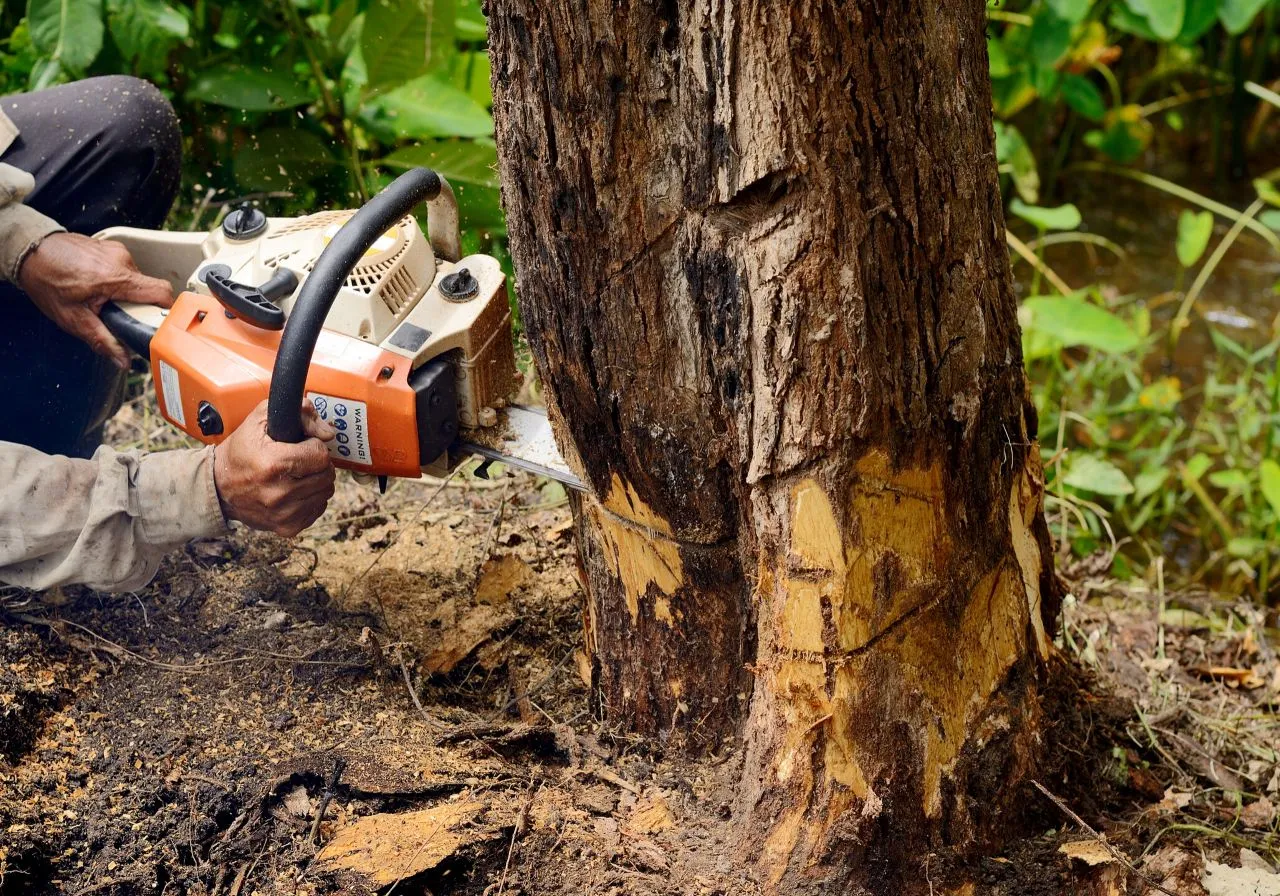
After 27 years working across Newcastle and the Hunter Region, certain trees come up again and again. The calls are almost always the same, roots through a pipe, branches through a roof, a stump that keeps reshooting, or a tree that looked fine until it didn’t.
Here are the six species we remove most often, and what homeowners usually say when we arrive.
Here are the six species we remove most often, and what homeowners usually say when we arrive.
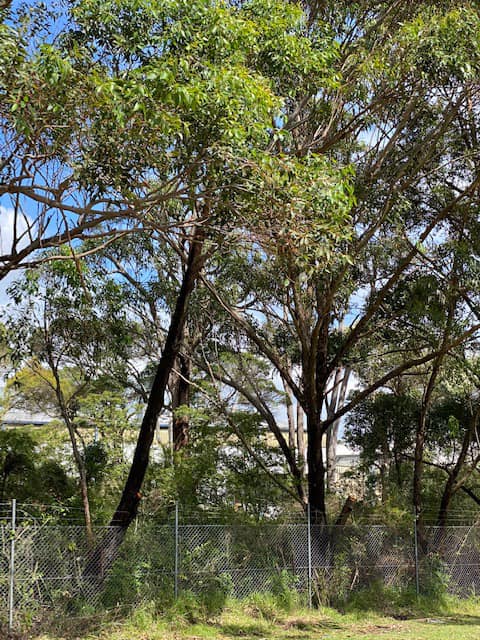
1. Cocos Palm (Syagrus romanzoffiana)
- The number one palm removal job we get called to across Newcastle and Lake Macquarie.
- Looks tropical and low-maintenance when small. Within ten years it’s 10-15 metres tall with no practical way to reduce it.
- Fruits drop constantly, attracting fruit bats, staining driveways, and creating a slip hazard.
- Unlike native palms, the fronds are heavy and sharp. Falling fronds cause real damage.
- No pruning option once it outgrows the space, removal is the only fix, and it requires specialist equipment at that height.
- What homeowners say when we arrive: “We had no idea it would get this big.”
2. Manchurian Pear (Pyrus ussuriensis)
- Sold hard as a decorative street and garden tree through the 2000s. We’ve been cleaning up the consequences ever since.
- The roots are aggressive and shallow, we regularly find them under driveways, lifting paths, and inside stormwater pipes.
- Drops significant leaf litter despite being marketed as a tidy deciduous ornamental.
- Then there’s the smell. When it flowers in spring, the blossoms smell unmistakably like semen. It’s well documented, widely complained about, and something no nursery ever mentioned at point of sale.
- Has naturalised in parts of the Hunter Valley, listed as a potential environmental weed.
- What homeowners say when we arrive: “The roots have got under everything, and honestly, the smell every spring was the last straw.”
3. Camphor Laurel (Cinnamomum camphora)
- Declared a Regionally Controlled Weed under the NSW Biosecurity Act 2015 across much of the Hunter Region, including active management requirements in Maitland City Council and Lake Macquarie City Council areas. If you have one on your property, you may have a legal obligation to manage it.
- Releases allelopathic chemicals that suppress everything growing beneath it, lawns, garden beds, neighbouring plants.
- Grows fast and large. Root systems are enormous and persistent, stump grinding alone rarely solves it.
- Regrowth from remaining roots is aggressive. Incorrect removal technique makes the problem significantly worse.
- Removal requires council consent in most Hunter Region LGAs, even though it’s a declared weed. The declaration and the permit requirement operate independently. Always check before you act.
- What homeowners say when we arrive: “We tried to deal with it ourselves and now there are shoots coming up everywhere.”
4. Yucca (Yucca elephantipes and related species)
- A legacy of 80s and 90s landscaping fashion. We remove these regularly across older Newcastle properties.
- The structural problem is invisible, stems decay from the inside while looking perfectly healthy from the outside. By the time it’s visibly deteriorating, it’s already a hazard.
- Leaves are razor-sharp. A falling stem or toppling trunk causes serious injury risk.
- Removal is complicated, any offcuts or root material left in the soil will reshoot. Full extraction is essential.
- What homeowners say when we arrive: “It just fell over. We didn’t even know it was rotten inside.”
5. White Cedar / Cape Lilac (Melia azedarach)
- Common in older Newcastle suburbs, often inherited with a property purchase, already well established.
- The berries are toxic to dogs and humans. Families with young children or pets call us regularly over this.
- Branches are brittle and fail in storms without warning, a significant liability concern near structures or fences.
- Self-seeds prolifically. After removal, seedlings keep appearing for years if the site isn’t managed.
- What homeowners say when we arrive: “The dog got into the berries and we just want it gone.”
6. Privet (Ligustrum lucidum, Large-leaved Privet)
- Declared a Regionally Controlled Weed under the NSW Biosecurity Act 2015 across most Hunter Region LGAs, meaning landowners have a legal duty of care to prevent it spreading. It is also illegal to sell, propagate, or knowingly distribute.
- Despite this, it remains one of the most common trees we’re called to remove across Newcastle and Lake Macquarie suburbs. Decades of bird distribution mean it’s established everywhere.
- The flowers are the notorious part, the pollen is one of the most significant hayfever triggers in the Hunter Region. Neighbours three doors down notice when it’s flowering.
- Berries are prolific and bird-distributed. Remove one tree and you’ll be pulling seedlings from your garden beds for the next three years.
- Establishes in fence lines, under structures, and in hard-to-access corners, making removal more complex and expensive the longer it’s left.
- What homeowners say when we arrive: “The neighbours have been asking us to do this for years.”
Got one of these trees on your property?
Steven Brown and the Waratah team remove problem trees across Newcastle, Lake Macquarie, Maitland, and Port Stephens every week.
Call 0414 706 653 for an obligation-free quote, or book an onsite arborist consultation from $110.
A note on weed declarations: Under the NSW Biosecurity Act 2015, some trees on this list are declared Regionally Controlled Weeds, meaning landowners have active legal obligations to manage them.
This is separate from council tree permit requirements, you may need both a weed management plan and removal approval. If you’re unsure where you stand, we can advise during a consultation.
FAQs
Q: Do I need council approval to remove these trees in Newcastle?
A: In most cases, yes, even for declared weeds like Privet and Camphor Laurel. City of Newcastle and most Hunter Region LGAs require a permit for the removal of trees above a certain size. We can advise during a consultation.
Q: Can I remove a problem tree myself?
A: For small specimens, possibly. For anything established, particularly Camphor Laurel, Yucca, or Cocos Palm, DIY removal creates more problems than it solves. Camphor Laurel regrows aggressively from mishandled roots. Yucca reshoot from any material left in the ground. And palm removal at height is genuinely dangerous without the right equipment.
Q: How much does it typically cost to remove one of these trees?
A: It depends on size, access, and complexity. A Cocos Palm at full height is a very different job to a young Manchurian Pear. We provide obligation-free quotes, call 0414 706 653 or use our contact form.
Q: My neighbour has one of these trees and it’s affecting my property. What can I do?
A: You have the right under common law to trim branches and roots back to the boundary line. Beyond that, the Trees (Disputes Between Neighbours) Act 2006 (NSW) provides a formal pathway if a tree is causing damage or posing a risk. An arborist assessment is often the most effective first step.
Q: Is Privet really that bad for hayfever?
A: Yes. Ligustrum lucidum pollen is one of the most significant allergenic tree pollens in the Hunter Region. The Newcastle and Hunter Valley airshed sees elevated Privet pollen counts every spring. If someone in your household suffers seasonal hayfever, a mature Privet on or near your property is worth removing on health grounds alone.
Our Services
Get In Touch
Contact us today for a free, no-obligation quote on our professional tree care services.