
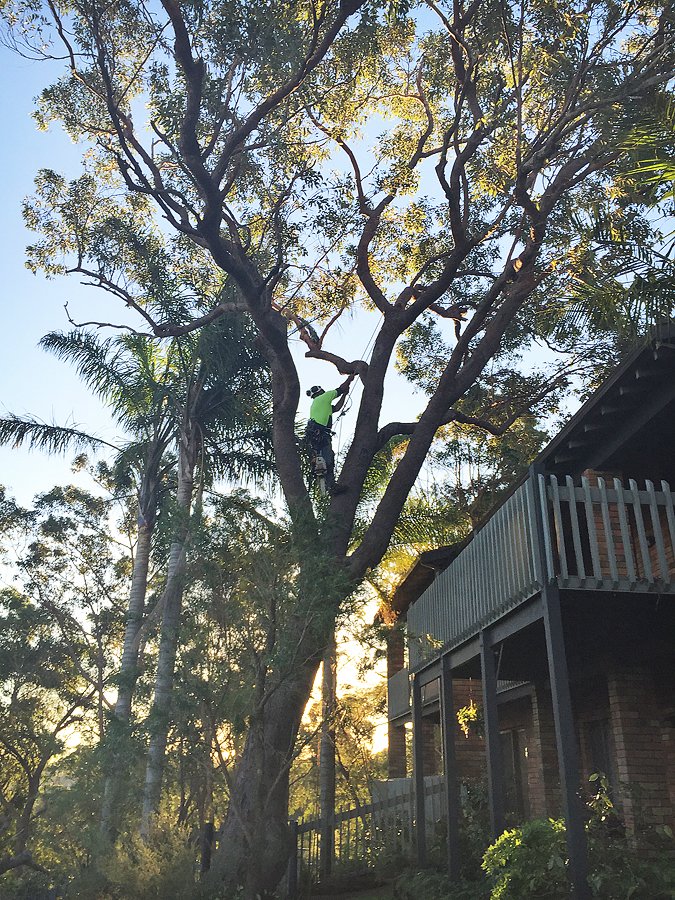
Short answer: in NSW the law does not decide a boundary tree by where the branches fall. It looks at where the trunk goes into the ground. Under the Trees (Disputes Between Neighbours) Act 2006, the Land and Environment Court can only make an order against a landholder about a tree that is on their land, which means at least half of the tree’s trunk enters the ground on their side.
The person whose land the tree is on is the person expected to look after it. What you can do about the part hanging over your side is a separate question again, and the answer changes depending on which council you are in.
Important note: This is general information about how the process works in NSW, not legal advice, and it is not a prediction of how any particular case would be decided. Boundary tree situations turn on their own facts. For a serious dispute, get legal advice.
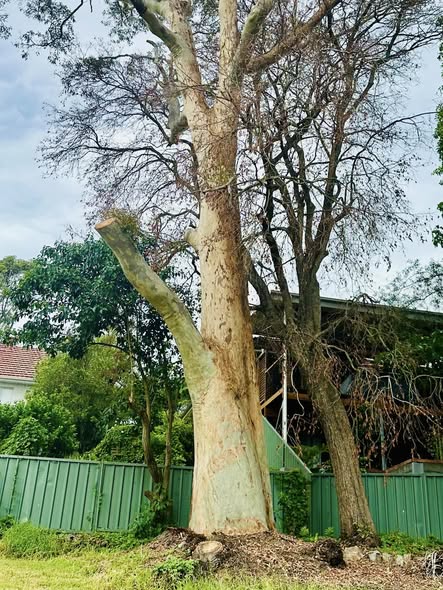
Whose Tree Is a Boundary Tree Under NSW Law
The Trees Act sets a clear test for the Court’s power. For the Court to make an order against someone about a tree on their land, the tree has to be located wholly or mainly on that land, which is put as at least fifty per cent of the tree’s trunk entering the ground there (Trees Act, section 4(3), as summarised by the State Library of NSW legal answers guide to trees and plants). So a tree that leans hard over your yard, drops its leaf litter on your roof and shades your back door can still sit squarely on your neighbour’s side of the test, because the trunk decides it.
Two more limits come with that. The tree has to be on privately owned land in an urban zone the Act applies to, and it has to be on land adjoining the land of the neighbour affected by it (sections 4, 7 and 14B, as set out by the Land and Environment Court). Adjoining has been read broadly enough to cover properties that adjoin diagonally and share only a corner post (Cavalier v Young [2011] NSWLEC 1080, noted in the State Library of NSW guide), but it does not stretch to a tree several houses away.
It is also worth knowing what counts as a tree here, because it is wider than most people expect. Legal Aid NSW explains that a tree includes any woody perennial plant and any plant resembling a tree in form and size, and that bamboo, tiger grass or giant clumping grass, and vines are all recognised as trees (Legal Aid NSW, Trees). Legal Aid NSW also sets out the separate hedge test, which is two or more trees over 2.5 metres high measured from ground level and planted together to form a hedge.
Where a trunk genuinely straddles the line, the position is not simple and it is not something to work out from a blog. That is the one to get proper advice on before anyone starts cutting.
What Being Responsible for a Boundary Tree Actually Means
Legal Aid NSW puts the maintenance side plainly: you are responsible for looking after trees on your property. In practice that means the owner is the one who arranges inspection, pruning and, where it is warranted, removal, and the one who deals with the council approval that sits over all of it.
Owning the tree does not mean you can do what you like with it. In the City of Newcastle area, a tree three metres or more in height, or with a trunk diameter of 15 centimetres or more measured 1.4 metres above the ground, is declared vegetation and needs a council permit before it is cleared. Pruning is treated separately. A permit is not required for pruning declared vegetation where the work would not amount to clearing under the Biodiversity and Conservation SEPP definition, and the pruning is done in accordance with AS 4373 to 2007, including by a person trained to AQF Level 3 in Arboriculture or above (Newcastle DCP 2023, Section C3, control C-3). That is the practical reason to have a qualified arborist on a boundary tree rather than someone with a ladder.
Trimming Overhanging Branches Back to the Boundary
This is the part everyone wants a yes or no on, and the honest answer is that it depends on your council and on the tree. Legal Aid NSW advises that if your neighbour’s tree has overhanging branches, you should speak to your neighbour and check with your local council before cutting back to the boundary, because some trees are protected and you need council permission before you cut. You can be fined if you interfere with a protected tree. It also warns that you must not enter your neighbour’s land without their permission or damage the tree, because you may be trespassing.
The local detail matters, and it genuinely differs across the three councils we work in most:
- Lake Macquarie: branches from native trees overhanging from a neighbouring property can be pruned back to the boundary as long as the pruning does not exceed 10 per cent of the tree canopy (Lake Macquarie City Council, tree pruning and removal).
- Maitland: where a tree on an adjoining property overhangs your boundary and the written consent of the owner cannot be obtained, council may approve pruning of the tree to the common property boundary only (Maitland City Council, Application Guide for Tree Removal and Pruning).
- Newcastle: pruning that stays short of clearing and is carried out to AS 4373 by someone qualified to AQF Level 3 or above does not need a permit, and anything beyond that does.
Maitland also makes the flip side explicit. Council cannot approve the removal or pruning of a tree on a neighbour’s property without that owner’s consent, so an application lodged on someone else’s behalf needs their consent attached.
Maitland and Lake Macquarie both frame the limit the same way, which is to the boundary and no further, and each puts its own conditions on top. Those conditions are the part that decides your job, so the council is the call to make before the saw comes out. Who pays for the trimming is not settled by any of these rules, so it is something the two of you work out. Our guide to neighbour tree disputes walks through what happens when you cannot agree. For the bigger jobs, correct tree pruning by a qualified arborist protects the tree and keeps you inside what the council actually allows.
Who Pays When a Boundary Tree Causes Damage
There is no simple rule that says the tree’s owner automatically pays, and we are not going to pretend there is. What the official guidance describes is a process and a set of tests, not a promise about how it will end.
On storm damage specifically, Legal Aid NSW says that if your neighbour’s tree fell on your property during a storm, your neighbour may not be responsible for the damage, and can only be responsible if they knew, or should have known, that the tree was dangerous. On insurance, its advice is simply to check your product disclosure statement to see what you are covered for, which is a question for your insurer rather than for us.
If you cannot reach agreement, the Trees Act gives you a path. Legal Aid NSW sets out the practical first steps: photograph the damage, speak to your neighbour, and get a written quote for the repairs. Then, if negotiation or mediation does not resolve it, an application can be made to the Land and Environment Court, which may order that the tree be removed or maintained, or that compensation be paid.
What the Court Has to Be Satisfied Of Before a Tree Dispute Goes Ahead
Section 10 of the Trees Act is the part that decides whether an application goes anywhere. As the State Library of NSW guide sets it out, the Court cannot make an order under Part 2 unless it is satisfied of three things:
- Agreement: the applicant has made a reasonable effort to reach agreement with the other party.
- Notice: the applicant has given proper notice of the application.
- Harm: the tree has caused, is causing, or is likely in the near future to cause damage to the applicant’s property, or is likely to cause injury to a person.
On that second point, notice runs to 21 days under section 8, including the terms of the order sought, and the Land and Environment Court requires the application to be served on both the neighbour and the local council at least 21 days before the preliminary hearing.
If those conditions are met, the Court then works through the matters in section 12. The State Library of NSW guide lists them, and they include:
- Position: the location of the tree in relation to the boundary and any premises.
- The tree itself: the impact that pruning would have on it.
- Amenity: what the tree contributes to privacy, landscaping, heritage value and shelter from sun, wind and noise.
- Environment: its contribution to the local ecosystem and biodiversity, and its effect on soil stability and the water table.
- Other causes: anything other than the tree that contributed to the damage, including acts or omissions by the applicant.
- Conduct: the steps either party has already taken to prevent or fix the problem.
The Court has also been clear that ordinary mess is not enough. The usual dropping of leaves, flowers, fruit, seeds or small amounts of deadwood will not ordinarily justify an order to interfere with or remove a tree, a principle traced to Barker v Kyriakides [2007] NSWLEC 292 and summarised in the State Library of NSW guide.
Two practical points catch people out. Where a tree has damaged a dividing fence on the boundary and the applicant asks for that damage to be fixed, the Land and Environment Court says it may also make an order about the dividing fence under section 13A of the Dividing Fences Act 1991. And orders made under the Trees Act may, in certain circumstances, be binding on a subsequent owner of the land under sections 16 and 16A (State Library of NSW guide), which is worth knowing if you are buying or selling a property with a known problem tree.
On timing, Legal Aid NSW notes you have six years from the date your property was damaged to claim compensation, and there is no time limit on applying to the Court unless you are asking for compensation. The Land and Environment Court says the preliminary hearing is usually four to six weeks after filing, and that applications under the Trees Act are usually dealt with within three months.
A Sensible Order to Sort Out a Boundary Tree
- Work out where the trunk enters the ground, because that decides whose tree the Act treats it as.
- Ring your council and ask whether that tree is protected and what pruning is allowed at your address.
- Have the tree assessed properly if safety or damage is in the picture, so you and your neighbour are both dealing in facts rather than opinions.
For the full step by step on the formal side, including mediation and what to file, see our detailed guide on what to do if a tree is causing a dispute with your neighbour in NSW. The two most common damage patterns we get called to are roots lifting paths and getting into drains and pipes, and limbs coming down onto fences, roofs and cars.
How a Qualified Arborist Helps With a Boundary Tree
Our job is the tree itself. We come out, look at the structure and the health of it, and tell you plainly what we see, including whether the thing that is worrying you is a real defect or just a big tree behaving like a big tree. If pruning is the answer, we prune to AS 4373 so the tree seals its wounds and stays stable. If the tree is genuinely beyond that, we talk to you about removal and what has to happen with your council first.
We work across Newcastle, Lake Macquarie, Maitland and the wider Hunter, and we have been doing it since 1998. Who is liable is a question for a solicitor and for the Court. Our part is telling you what the tree is doing.
Where These Boundary Tree Rules Come From
- Land and Environment Court of NSW, tree and hedge disputes, how to start an application and outcomes and orders
- Legal Aid NSW, Trees
- State Library of NSW, Trees and plants
- Newcastle DCP 2023, Section C3 Vegetation preservation and care
- Lake Macquarie City Council, tree pruning and removal
- Maitland City Council, Application Guide for Tree Removal and Pruning
Frequently Asked Questions About Boundary Tree Responsibility
Whose tree is it if it grows on the boundary line?
Under the Trees (Disputes Between Neighbours) Act 2006, the Land and Environment Court can only make an order about a tree that is wholly or mainly on a person’s land, which is put as at least fifty per cent of the trunk entering the ground there. Branches and roots crossing the line do not change that test. Where a trunk truly straddles the boundary the position is not straightforward, so get legal advice before anyone cuts.
Can I cut my neighbour’s tree branches that hang over my fence?
Sometimes, and it depends on your council and the tree. Legal Aid NSW advises speaking to your neighbour and checking with your council first, because protected trees need council permission and you can be fined for interfering with one. Lake Macquarie allows overhanging branches of native trees to be pruned back to the boundary provided the work does not exceed 10 per cent of the canopy. You cannot enter your neighbour’s land without permission.
Who is responsible for maintaining a tree on the boundary?
Legal Aid NSW puts it simply: you are responsible for looking after trees on your property. Under the Trees Act the tree counts as being on a person’s land where at least fifty per cent of its trunk enters the ground there. That owner is the one who arranges inspection and pruning and who deals with the council approval, and council approval still applies to them even though it is their own tree.
Do I need my neighbour’s permission to lodge a council application about their tree?
Yes. Maitland City Council states that it cannot approve the removal or pruning of trees on a neighbour’s property without the relevant owner’s consent, and an application lodged on an owner’s behalf has to include that consent. Other councils in the region take the same approach, so check with yours.
What if it’s a protected or heritage tree on the boundary?
Protection applies to the tree, including the part hanging over your side, so being on your side of the fence does not override it. You would need to follow your council’s process, and in Newcastle a tree on a heritage item or visible from the street in a heritage conservation area sits outside the ordinary exemptions altogether. Have it assessed before anyone touches it.
What Others Are Reading:
Our Services
Get In Touch
Contact us today for a free, no-obligation quote on our professional tree care services.